
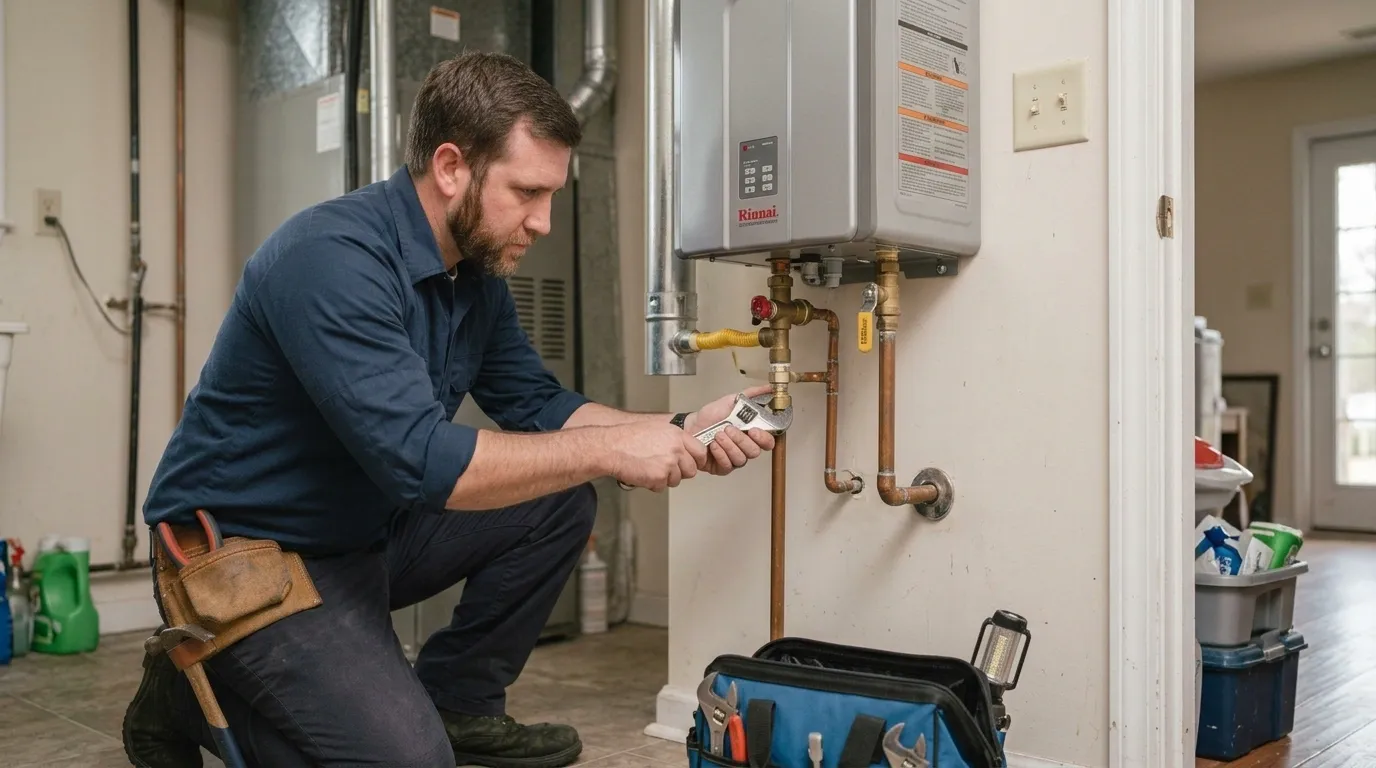
Tankless Water Heaters in Tupelo, MS
On-demand hot water — whether it's the right fit, installation, maintenance, and repair.
A tankless water heater heats water as it flows through the unit instead of storing and continuously heating a tank of water. That removes the standby tank altogether, but it also means performance depends on the system's rated capacity rather than how much water happens to be sitting in a tank.
What Is a Tankless Water Heater?
Water enters the unit, passes over a heating element or heat exchanger, and comes out hot — all in the time it takes to flow through, with no tank storing water in advance. Because there's no reservoir, a tankless unit's performance depends on its rated flow and heating capacity relative to how much hot water is actually being asked of it at once, along with the temperature of the water coming in.
Tankless vs. Traditional Tank Water Heaters
Tankless systems have some real advantages: on-demand heating with no large storage tank, a smaller, often wall-mounted footprint, reduced standby heat loss since there's no tank sitting full of hot water around the clock, and often a longer service life than a typical tank unit. The tradeoffs are a higher upfront equipment cost, flow and capacity limits that depend on the specific unit, more particular installation requirements, and system sizing that matters more than it does with a tank.
A traditional tank system stores and continuously heats a reserve of hot water. It generally costs less upfront, needs physical space for the tank, and draws from that stored reserve during periods of high demand rather than heating water in real time. Neither type is universally better — the right choice depends on the household and the installation itself.
Is a Tankless Water Heater Right for Your Home?
Suitability depends on more than household size. Relevant factors include how much hot water demand happens simultaneously (multiple showers, a dishwasher, and a washing machine all running at once is a different situation than one fixture at a time), the flow rate and temperature rise a household actually needs, the incoming water temperature, available fuel source and electrical capacity, the installation location, and budget. A properly sized tankless system can provide continuous hot water while demand stays within its rated flow and heating capacity — but demand that exceeds that capacity will still be limited, the same way an undersized tank runs out.
Tankless Water Heater Sizing
Sizing a tankless unit is a different calculation than choosing a tank's storage capacity. It comes down to the maximum simultaneous flow the household needs — how many fixtures might reasonably run at once — along with the temperature rise required, which depends on how cold the incoming water is relative to the desired output temperature. Available gas or electrical capacity at the installation location also factors in, since larger-capacity units require more fuel or power to operate. The right size for a specific home is confirmed against the manufacturer's rated output during an assessment, not estimated from a general rule.
Tankless Water Heater Installation
- Assess the existing system and installation location
- Determine the appropriate tankless system and capacity for the household
- Confirm available fuel or electrical service
- Evaluate required connections and installation conditions
- Address venting requirements for applicable gas systems
- Connect water lines and system components
- Configure and test the system
- Confirm proper operation
See Water Heater Installation for the broader installation and replacement process that applies across water heater types.
Tankless Water Heater Maintenance
Maintenance needs vary by unit and water conditions. Mineral and scale buildup inside the heat exchanger is the most common long-term concern, particularly with harder water, since it can affect efficiency and performance over time. Some systems have filters that need periodic attention. Manufacturer-specific maintenance recommendations are the most reliable guide for a given unit, rather than a single fixed interval that applies to every system.
Repairing an Existing Tankless Water Heater
Tankless units have their own set of failure points, distinct from a tank system's troubleshooting — flow sensors, heat exchangers, ignition components on gas units, and error codes the unit itself can display. Common symptoms include inconsistent hot water, a unit that isn't heating at all, reduced flow, or an active error condition. Diagnosis depends on the specific unit and symptoms, so a plumber identifying the actual cause is more reliable than guessing from the symptom alone. See Water Heater Repair for general water heater troubleshooting that applies across unit types.
When Tankless Repair May Make More Sense Than Replacement
Whether to repair or replace a tankless unit depends on its age and condition, what the specific failure is, whether replacement components are reasonably available, and whether the unit still meets the household's current hot water demand. A component-level issue on an otherwise sound unit is often repairable; a unit that's failed significantly or no longer meets household needs may be a better candidate for replacement.
Can You Replace a Traditional Water Heater With Tankless?
Often, yes, but it's not always a simple one-for-one equipment swap. Switching from tank to tankless can involve evaluating available fuel source, electrical capacity, venting requirements for gas units, how water lines connect, the installation location, and whether the plumbing configuration needs any adjustment. See Water Heater Installation for how that evaluation works.
Frequently Asked Questions
What is a tankless water heater?+−
A water heater that heats water on demand as it flows through the unit, rather than storing and continuously heating a tank of water in advance.
Are tankless water heaters worth it?+−
It depends on the household — tankless systems offer space savings and reduced standby heat loss, but cost more upfront. The right fit depends on hot water demand, budget, and installation requirements.
Can a tankless water heater run multiple showers at once?+−
It depends on the unit's rated flow capacity, the incoming water temperature, and the required temperature rise — demand within the unit's capacity is fine, but exceeding it will limit performance the same way an undersized tank would.
How long do tankless water heaters last?+−
Tankless units can have a longer service life than many traditional tank systems, though actual lifespan depends on the unit, water conditions, and maintenance.
Do tankless water heaters need maintenance?+−
Maintenance needs can be important depending on the system and local water conditions, particularly around mineral and scale buildup in the heat exchanger.
Do gas tankless water heaters need special venting?+−
Gas tankless units can have specific venting requirements that depend on the equipment and installation — this gets confirmed as part of the installation assessment.
Can a traditional water heater be replaced with tankless?+−
Often, yes, but it requires evaluating available fuel source, electrical capacity, venting, and the installation location rather than assuming a direct swap.
What size tankless water heater do I need?+−
Sizing depends on simultaneous flow demand, incoming water temperature, and required temperature rise, confirmed against a specific unit's rated output during an assessment.
Can a tankless water heater be repaired?+−
Many tankless issues — including flow sensor, heat exchanger, and ignition-related problems — are repairable, depending on the specific unit and failure.
Why isn't my tankless water heater producing enough hot water?+−
Possible causes include demand exceeding the unit's rated capacity, scale buildup affecting the heat exchanger, or a sensor or component issue — a plumber can confirm the actual cause for a specific unit.